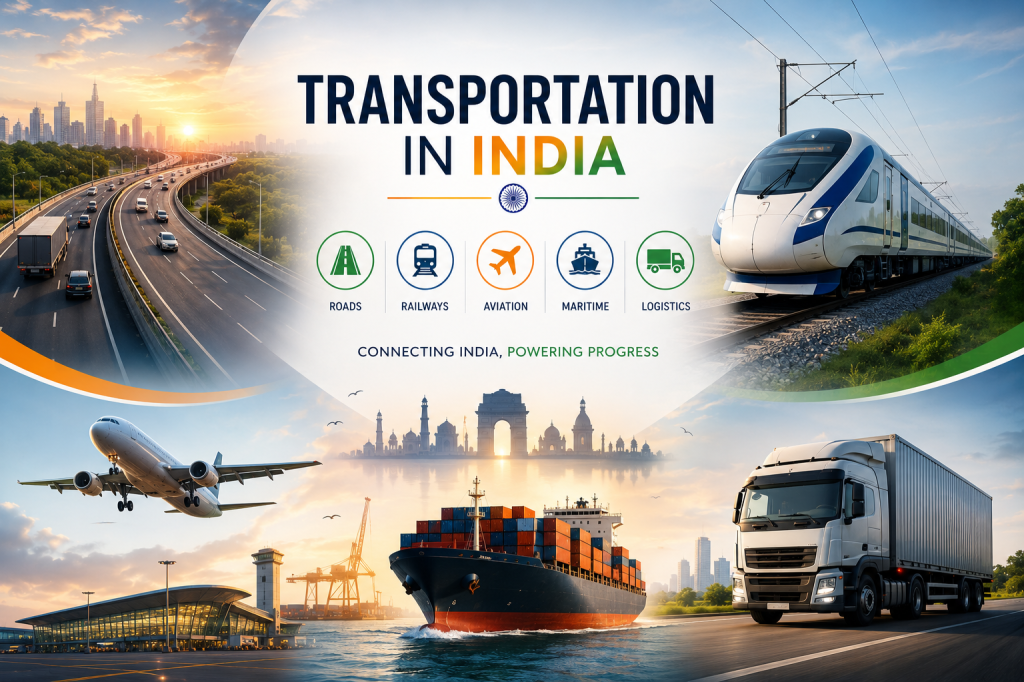
India’s transportation sector is one of the largest in the world, supporting a population of over 1.4 billion people and a rapidly growing economy. Efficient transportation is essential for trade, mobility, industrial development, and national connectivity.
Key Numbers
- India has over 6.6 million km of roads, the second-largest road network in the world.
- More than 350 million registered vehicles operate across the country.
- Indian Railways transports approximately 8 billion passengers and 1.5 billion tonnes of freight annually.
- India’s aviation sector serves over 220 million domestic passengers annually.
- Around 95% of India’s trade volume is carried through maritime transport.
- The logistics sector contributes nearly 14% of India’s GDP.
Why Transportation Matters
1. Economic Growth
Transportation connects industries, suppliers, and consumers, enabling efficient movement of goods and services.
2. Employment Generation
The sector provides millions of jobs in logistics, infrastructure, manufacturing, and services.
3. Regional Development
Improved connectivity helps integrate rural areas with urban markets and opportunities.
Key Players in India’s Transportation Ecosystem
🚂 Indian Railways
- Operates over 68,000 km of rail tracks.
- Backbone of passenger and freight transportation.
🚚 Delhivery
- One of India’s largest logistics and supply-chain companies.
- Handles millions of shipments annually.
🚛 Container Corporation of India (CONCOR)
- Leading rail-based container logistics provider.
- Supports domestic and international trade.
✈️ IndiGo
- India’s largest airline by market share.
- Connects over 100 destinations.
🚢 Adani Ports and Special Economic Zone
- India’s largest private port operator.
- Handles a significant share of national cargo traffic.
Three Major Challenges
1. Weak Rural Connectivity
Many villages still lack efficient road and transport access.
2. Costly Air Travel
Air transportation remains expensive for most Indians.
3. Poor Farm Logistics
Limited cold storage and transport lead to agricultural losses.
The Road Ahead
- Development of air transport and freight corridors.
- Adoption of electric vehicles and exponential growth in railway projects.
- Investment in multimodal logistics parks and smart infrastructure.
Conclusion
Transportation is the backbone of India’s economic development. With one of the world’s largest road, rail, aviation, and maritime networks, the country is investing heavily to meet future demand. Addressing rural connectivity, affordable air travel, and agricultural logistics will be crucial for building a faster, more inclusive, and globally competitive transportation system.
 Arth-Research
Leave a comment