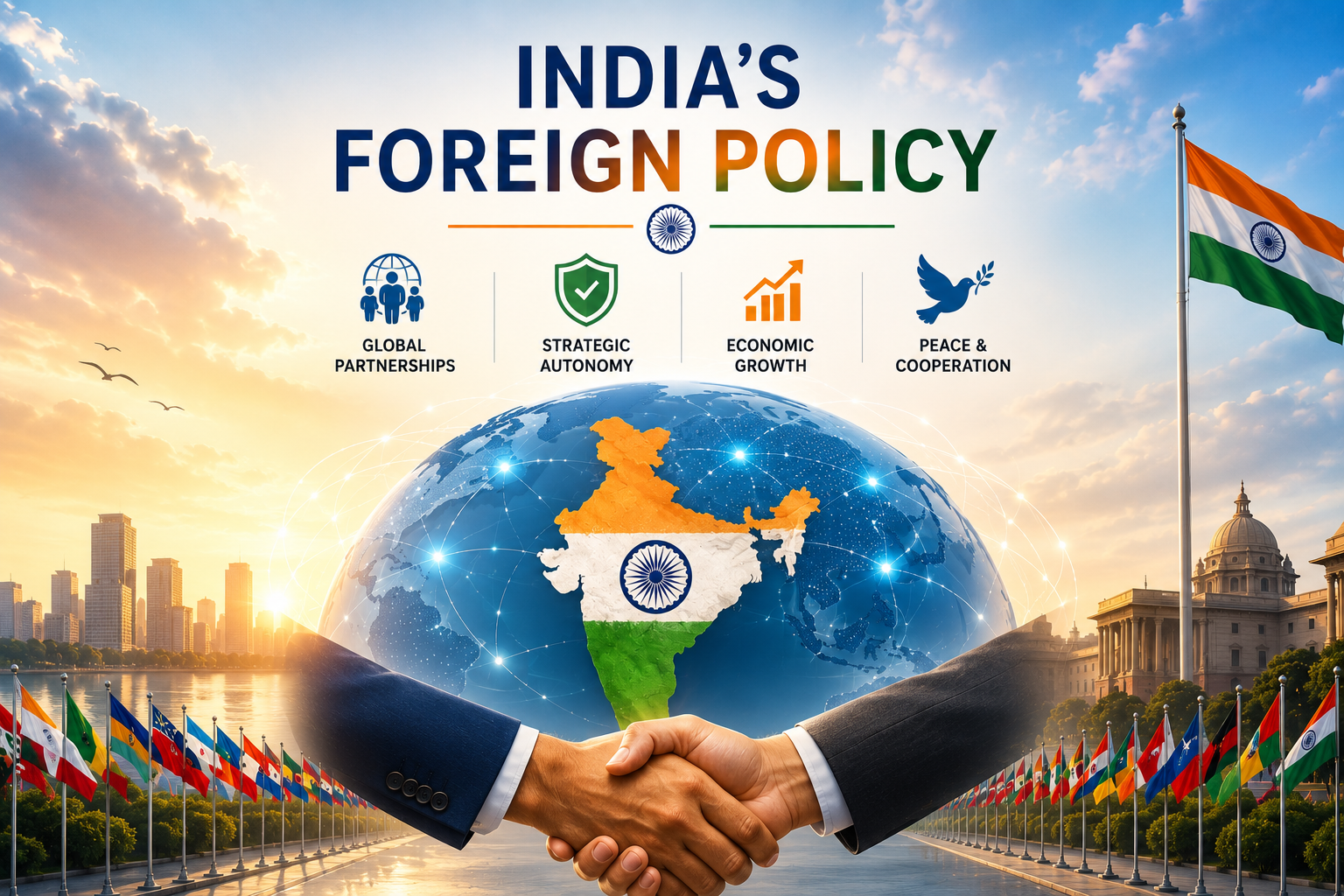
India’s foreign policy is centered on strategic autonomy, economic growth, and international cooperation. Over the years, India has strengthened its ties with major global powers while emerging as a leading voice for developing nations.
Key Highlights
- India is a member of major global forums such as the G20, BRICS, SAARC, and SCO.
- India’s exports have crossed $800 billion annually, supported by growing international partnerships.
- The country maintains diplomatic relations with more than 190 nations worldwide.
India’s Strong Relationships with Key Countries
🇺🇸 United States
- India and the United States are strategic partners in technology, defense, space, and trade.
- Bilateral trade exceeds $190 billion annually.
- Cooperation includes semiconductor manufacturing, artificial intelligence, and clean energy initiatives.
🇫🇷 France
- France is one of India’s closest defense partners.
- India has purchased Rafale fighter aircraft and collaborates with France in the Indian Ocean region.
- The two countries also work together on climate action, nuclear energy, and space research.
🇯🇵 Japan
- Japan is a major investor in India’s infrastructure sector.
- Projects such as the Mumbai-Ahmedabad High-Speed Rail (Bullet Train) showcase the strength of this partnership.
- Both countries cooperate closely through the Quad alliance to promote a free and open Indo-Pacific.
🇦🇪 United Arab Emirates
- The UAE is one of India’s largest trading partners in the Middle East.
- The Comprehensive Economic Partnership Agreement (CEPA) has boosted trade and investment.
- Cooperation extends to energy security, logistics, fintech, and food security.
Pillars of India’s Foreign Policy
1. Strategic Autonomy
India maintains independent decision-making while engaging with multiple global powers.
2. Economic Diplomacy
Trade agreements and investment partnerships help drive economic growth and job creation.
3. Regional Stability
India promotes connectivity, development, and security cooperation with neighboring countries.
4. Global Leadership
India actively contributes to climate action, disaster relief, peacekeeping, and sustainable development initiatives.
Why It Matters
A strong foreign policy helps India:
- Attract foreign investment.
- Secure energy supplies.
- Expand export opportunities.
- Strengthen national security.
- Increase its influence in global decision-making.
Conclusion
India’s foreign policy combines pragmatism with ambition. Through strong partnerships with countries such as the United States, France, Japan, and the UAE, India has enhanced its economic strength, technological capabilities, and global influence. As the world’s fastest-growing major economy, India is increasingly shaping the future of international cooperation and global development.
 Arth-Research
Leave a comment