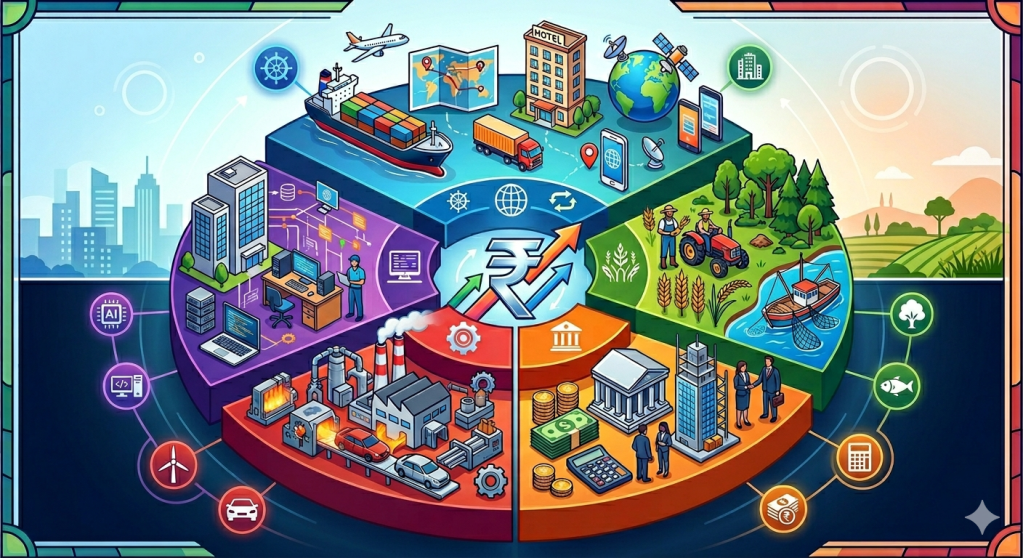
India’s multi-trillion-dollar economy is driven by three major macroeconomic pillars: Services (~55%), Industry (~28%), and Agriculture (~17%).
Breaking these down into specific sectors, here are the top 5 contributing industries by the numbers:
📊 The Top 5 Sectors By The Numbers
- 1. Hotels, Transport & Communication
- GDP Contribution: Consistently accounts for 18% to 20% of the country’s total economic output.
- Impact: The single largest component within India’s dominant service sector.
- 2. Agriculture, Forestry & Fishing
- GDP Contribution: Contributes between 17% and 19.7% to the national nominal GDP.
- Livelihood Impact: Sustains and employs over 40% to 44% of India’s total workforce.
- 3. Financial, Real Estate & Professional Services
- GDP Contribution: Commands a major 15% to 16% share of the national economic output.
- Driver: Propelled by booming credit growth and massive digital transaction volumes via UPI.
- 4. Manufacturing & Heavy Industry
- GDP Contribution: Contributes roughly 14% to 16% directly to the national GDP.
- Global Footprint: Forms the core of India’s industrial export strategy, heavily backed by government Production-Linked Incentive (PLI) schemes.
- 5. IT, Tech & Business Process Management (BPM)
- GDP Contribution: Accounts for nearly 7.5% to 8% of India’s total GDP.
- Export Share: Represents over 50% of India’s total service-based exports, positioning the country as the world’s digital hub.
🔮 Structural Summary
While Services generates the highest monetary value (~55%), Agriculture remains the largest provider of employment (~42%). The current economic strategy focuses on scaling Manufacturing to 25% of GDP to create a more balanced, multi-engine growth model.
 Arth-Research
Leave a comment