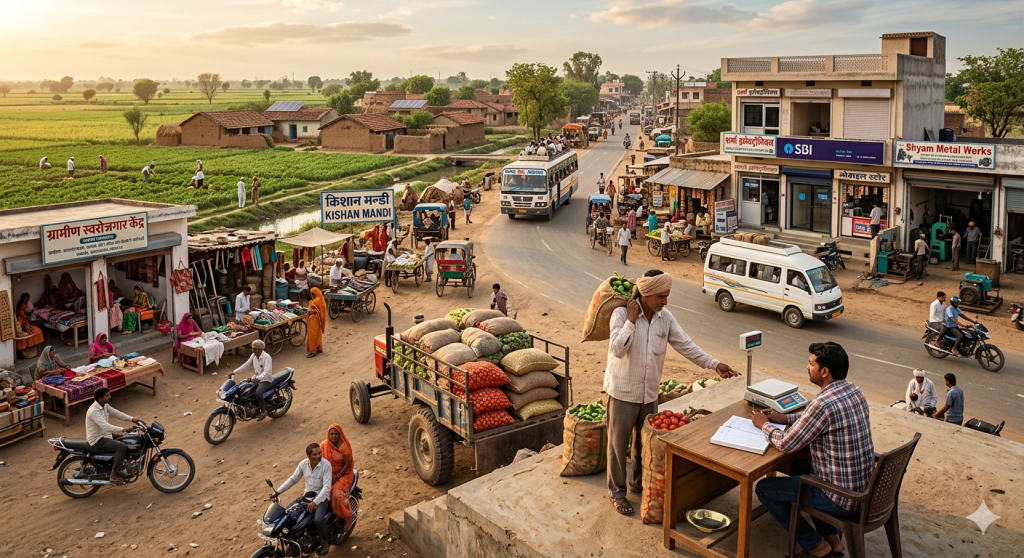
Rural and Semi-Urban Markets of India: Growth Beyond Metros:
Rural and semi-urban India account for nearly 65% of the population and contribute around 45% of total consumption demand, making them critical to economic expansion. These regions are no longer agriculture – dependent alone; their role in industry and GDP is steadily rising.
Agriculture still contributes about 15–18% of India’s GDP, but nearly 45% of the workforce depends on it. Increasingly, rural economies are diversifying into manufacturing, construction, and services. Semi-urban areas, especially Tier 2 and Tier 3 cities, are becoming hubs for MSMEs, contributing nearly 30% to India’s GDP and employing over 110 million people.
Industrial growth is spreading beyond metros due to lower costs and government initiatives like industrial corridors and “Make in India.” Many small-scale industries, textiles, food processing units, and agro-based industries are concentrated in semi-urban regions.
Digital adoption is accelerating this transformation. With over 750 million internet users, rural participation in e-commerce, fintech, and online services is rising rapidly. Rural markets already contribute 35–40% of FMCG sales, while demand for consumer durables is growing at 10–15% annually.
Challenges remain, including infrastructure gaps and income volatility. Logistics costs can be 20–30% higher in rural areas, impacting supply chains.
By 2030, rural consumption is expected to reach $2–2.5 trillion, significantly boosting India’s GDP. In conclusion, rural and semi-urban markets are emerging as key contributors not just to consumption, but also to industrial growth and national income.
 Arth-Research
Leave a comment